Online dating?
Free registrationThe Love Story of Máxima and Willem Alexander
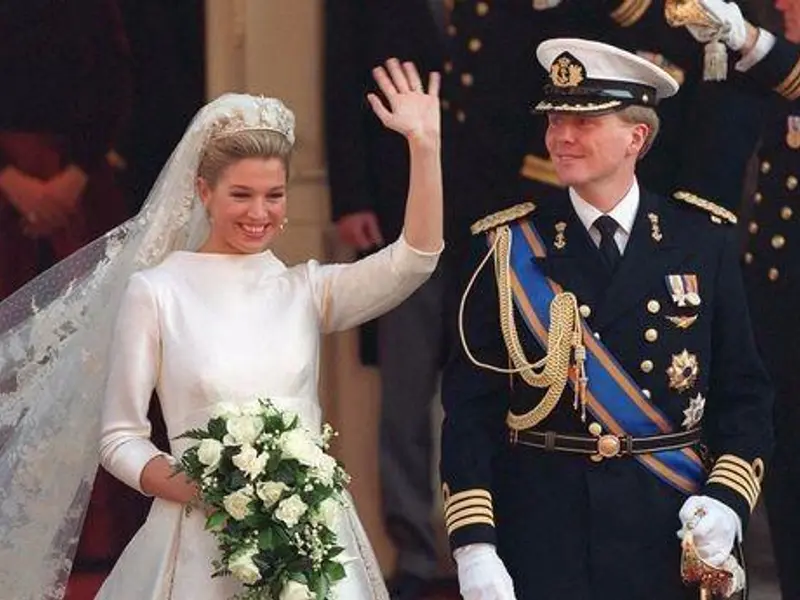
On 31 August 1999, the phone rings in Rio de Janeiro. On the line is de Volkskrant.
That morning, the Stan Huygens Journaal column in De Telegraaf had run an account of the wedding between Janus Smalbraak and Vanessa Loudon. Willem-Alexander had appeared, with a blonde Argentinian woman on his arm.
'She wore a black dress and drank red wine,' wrote Thomas Lepeltak.
He also mentioned her surname: Herzog, supposedly. De Volkskrant then calls correspondent Ineke Holtwijk. Could she find out who this Argentinian woman is?
Preferably in time for tomorrow's paper.
'No problem,' says Holtwijk.
She calls a friend in Argentina and asks him to look in the Buenos Aires phone book. 'Give me every number for people named Herzog.'
Holtwijk picks up the phone and calls them all. But the Herzogs of Buenos Aires give nothing away. She tracks down their namesakes across the rest of the country.
No luck. It's already well into the afternoon when she decides to simply call every wealthy person in Argentina she has a number for.
One by one she rings them, and within two hours the unbelievable happens: she picks up a trail.
'A businessman friend told me the couple had been to the ski resort of Bariloche together, to introduce Willem-Alexander to the family,'
Holtwijk says in an interview. 'He also recalled that she hadn't initially told them Alex was a prince.
Beyond that, he knew nothing about the girlfriend or her family.'
Half an hour later, she strikes gold.
'Would you like to know her name?' 'I already have it,' says Holtwijk. 'It's Zorreguieta.'
She gets another contact on the line. He says: 'Well, what a coincidence!
I only heard about the romance an hour ago through a friend. I couldn't believe it.
But now that you're calling me about it too, it must be true.'
She's one hundred per cent Argentinian, says the source, and her father was an important politician.
Just as Holtwijk is about to hang up, the man asks: 'Would you like to know her name?'
'I already have it,' says Holtwijk. 'Herzog.' 'No,' says the man. 'Her name is Zorreguieta.'
For four months they managed to keep their love a secret, Willem-Alexander and Máxima.
And that's impressive, because by then there had already been quite a number of encounters
since they first met in April, in Seville.
It happened during La Feria de Abril, a Spanish festival week that begins on Easter Monday.
During the day there are bullfights and horse races, and in the evening flamenco, sherry and tapas in the casetas — the marquees where the aristocracy regularly gathers.
Over the years, sporadic stories have emerged about their first meeting there.
They had been invited by mutual friends, they later explained at a press conference.
They came together with a large group. Máxima had been asked by the hostess to take photographs,
so several versions of the story go.
With a large lens in front of her face, she moved through the caseta. Before long, she snapped a photo of a tall, blond young man.
He reacted as if stung by a wasp.
Seeing his furious expression, Máxima made herself scarce. 'Who's that grumpy one?' she asked her friends.
Their mutual friends watched Alexander fall head over heels.
A flechazo, they called it — love at first sight.
But the feeling wasn't mutual. In a television interview, Máxima said of that moment:
'I thought: I need to steer well clear of this one. I'm an independent girl with all sorts of plans.
This really didn't fit in.'
A few weeks later, Máxima and Willem-Alexander meet again in New York.
Willem-Alexander has been invited to the wedding of his friend Frederik, Count van Lynden van Sandenburg, to Anne Louise Metz, in May 1999.
Together with his brother Constantijn, he flies to New York.
Constantijn is the only person who knows about the love blossoming in his eldest brother's heart.
A love that is not returned.
'I didn't feel anything for him,' Máxima later said. Yet they kept calling, and a second meeting in New York followed, three weeks later.
Before anything has even happened, Willem-Alexander now has to tell his mother something.
He has to explain why he can't come to a conference,
and why he's going to New York again.
In a television interview, Willem-Alexander put it like this:
'I said to my mother: "Her name is Máxima.
She's Argentinian, she lives in New York, and trust me. Don't ask any more questions."'
That spring, the crown prince flies to New York with striking regularity. Nobody recognises the prince.
'We had wonderful weekends in New York,'
he later said during a visit to the city.
According to Willem-Alexander, during this period they went 'rollerblading through Battery Park'.
If he could choose a souvenir, he said in the same interview,
it would be 'a piece of asphalt' they had glided over together on their rollerblades.
Máxima was working on Wall Street at the time, at Dresdner Kleinwort Benson.
That summer she accepted a new position as an asset manager at Deutsche Bank.
The long phone conversations she says she had with Willem-Alexander must often have touched on that.
Every account of this period mentions that Máxima was introduced to her future mother-in-law that summer at Beatrix and Prince Claus's Italian country retreat.
Álvarez Guerrero and Ferrari describe how Máxima went shopping like a woman possessed during her lunch break in New York.
She wanted to look perfect for this meeting. When she told Alexander, he said:
'How about a swimsuit?'
She wanted to look perfect. When she told Alexander, he said: 'How about a swimsuit?'
'Very nerve-wracking,' Máxima said afterwards about the meeting. She was thrown in at the deep end.
After meeting Queen Beatrix and Prince Claus, they travelled to Porto Ercole
for a boat trip on the Jumbo VI with Prince Bernhard and Princess Juliana.
A summer later, photographs surfaced of Máxima aboard the Jumbo in a burgundy swimsuit.
Prince Claus urged her from their very first meetings to learn Dutch quickly,
Máxima later said.
Queen Beatrix was warmer than ever.
In an interview with Nieuwsuur earlier that year, Ruud Lubbers let the secret slip.
According to the former prime minister, Queen Beatrix had always been highly critical of the girlfriends Willem-Alexander brought home.
When Máxima was about to be introduced to the queen,
Lubbers advised Beatrix 'to be nice for once'.
After the great introduction to Máxima, Beatrix called him straight away.
Laughing, she told him she'd had to explain to Claus and her 'boys' why she had suddenly dropped her critical attitude.
In the autumn and winter that followed, the couple flew back and forth.
Alexander was regularly with Máxima in New York.
Máxima was frequently in Europe during this time. Since de Volkskrant's scoop in September 1999, after which her existence was acknowledged by Prime Minister Wim Kok at a press conference,
she had been taking Dutch lessons.
Thanks to her teacher in New York, who later wrote a small book about her pupil,
we know that Máxima told her about wonderful weekends in Belgium and England where she met other royal and aristocratic figures.
At the end of that year, Queen Beatrix and Prince Claus departed with their children and partners for a week in India to celebrate the millennium.
Máxima went too, in the deepest secrecy. They stayed there for almost a week.
She already spoke a little Dutch by then. She told her teacher in New York that it had been 'hard work' there.
Her father's political background was also discussed extensively.
An anonymous source told NRC Handelsblad in 2001 that the sensitive past of her father had led to 'a fierce row between the crown prince and his two brothers':
'The crockery nearly flew across the room,' a court insider told the newspaper.
The flying back and forth was now in full swing. Máxima had little time to work.
First there had been the week in India, until 3 January.
On a cold Monday morning, 17 January, she was spotted in an Amsterdam café by two journalists from Vrij Nederland.
The Leiden professor Victor Halberstadt was having coffee with his daughter Jutka, who was the same age as Máxima, just a stone's throw from the Monday morning market in the Jordaan.
These were the first steps of her integration into Dutch life.
Those weeks must have been the strangest of this entire period.
The images of Máxima on the streets of New York show a 28-year-old anonymous woman, with a paper sandwich bag and a few loose dollar bills in her hand,
walking through the dark streets of Manhattan on a cold day, through the revolving door of a grey office building.
At the end of her working day we see her again, her back hunched against the cold wind, her hair in a messy ponytail,
on her way to a cheap Chinese nail salon. These are her last moments as an ordinary citizen.
The following weekend, Saturday 22 January, she is photographed by Edwin Smulders in New York.
At this point she is still listed in the phone book. Journalists call her en masse and reach an English-language voicemail with a Spanish accent.
Máxima, however, never calls back. When Smulders rings for the umpteenth time, she suddenly answers.
He immediately takes a plane to New York and begins staking out the door of her apartment, 225 West 20th Street,
and her workplace on Wall Street, until she appears.
That evening, Smulders also stakes out the entrance of restaurant Cipriani Downtown, on West Broadway, where she is dining with the prince.
Smulders waits until Willem-Alexander and Máxima leave the restaurant, and takes the first photograph of them together.
A week later, on Monday 31 January, just after Freddy Heineken stubs out his burning cigarette on the pavement outside Amsterdam's Stedelijk Museum, she appears.
In a demure silver suit, hidden behind Prince Constantijn, she steps off the royal bus. 'Máxima! Máxima!' the excited photographers call out.
By then, the row over her father has already erupted in full force.
But a court insider tells NRC Handelsblad that the royal family, by having her appear, wants to 'make a statement'.
The message is: the Netherlands may be agitated about Jorge Zorreguieta, but Máxima is the prince's girlfriend regardless.
'Máxima is simply getting on the bus,' Queen Beatrix is said to have declared.
After the millennium trip to India, in the spring of 2000, Máxima moves to an apartment in an upscale Brussels neighbourhood.
Her employer and the Government Information Service announce that this is due to 'an internal exchange programme' for Deutsche Bank employees.
First, Máxima attends the Ceran Lingua institute, where she takes an intensive Dutch course typically used by diplomats.
The Dutch lessons are given in a small château in the Ardennes, in the Belgian town of Spa.
Her teacher there later revealed on the television programme Knevel & Van den Brink that she had enrolled under a false name and 'learned remarkably quickly'.
It was only a year later, at the engagement, that the man realised who his pupil had been.
It is a relatively quiet time, during which Máxima is taken under the wing of former politician Andrée van Es for her introduction to the Netherlands, and by lady-in-waiting Lieke van Gaarlandt,
who teaches her the etiquette of the royal household — a role that Pien Zaaijer would take over from both of them in 2003.
In April, after closing time, she visits the Golden Age exhibition at the Rijksmuseum with Prince Constantijn and his wife Laurentien.
Those present say she was very interested in the Dutch masters, had a sense of humour and 'easy-going manners'.
From time to time, private images of the couple appear in the gossip magazines.
Occasionally we see the ordinary young woman passing by with a hand raised to fend off the photographer.
Genuine paparazzi shots are rare. 'LOVE HOLIDAY' reads the Weekend headline, and we see Máxima in Italy, in a swimsuit aboard the boat of 'grandfather' (Prince Bernhard).
That summer, a Privé photographer catches Queen Beatrix and Prince Claus in Brussels.
They are driving to the Belgian capital to meet Máxima's parents for the first time, on neutral ground.
In the background, a deep love is growing in relative peace, but in the foreground there is no peace at all.
The protest against Máxima's background swells, over the role her father played as a minister under the Videla regime.
In New York, a visibly emotional Willem-Alexander becomes so angry that during a press conference he defends his father-in-law
and cites precisely the wrong source (Videla himself) to defend the regime.
The entire country turns on him. An investigation is launched, meetings follow in New York and São Paulo between Jorge Zorreguieta and Dutch representatives.
According to a reconstruction in NRC Handelsblad, it is ultimately Máxima herself who, in a hotel room in São Paulo, convinces her father not to attend the wedding.
It becomes so tense that, according to this reconstruction, 'someone from court circles' says of this phase: 'We scraped through by the skin of our teeth.'
'Paul Witteman to Máxima: "And? What did you say?" Máxima: "Yes! Without thinking!"'
'I had a free afternoon,' says the crown prince. 'I'd already made my decision and thought: what could be more beautiful than to propose to Máxima in this classic Dutch setting?'
During the engagement press conference in 2001 and later, in an interview with NOS in 2008, Willem-Alexander and Máxima themselves describe how he proposed.
Paul Witteman and Maartje van Weegen are the interviewers.
It is 19 January, Friday afternoon, two o'clock. Alexander is with Máxima at Huis ten Bosch. The pond in the garden has frozen over.
There is debris on it and patches of thin ice, but he takes the chance. Máxima has never ice-skated before, but Alexander knows it won't be a problem
because she's a good rollerblader.
'Just give it a try,' he says.
She's indeed good at it, but before long she's cold and longs for hot chocolate. 'This is the moment,' the prince thinks.
Still on his skates, he clumsily makes his way to the bank, to the tea house where he has hidden roses and champagne. He clumsily makes his way back. And then he drops to one knee.
Paul Witteman to Máxima: 'And? What did you say?'
Máxima: 'Yes! Without thinking. I practically screamed it.'
Source: Vogue